
SCALER
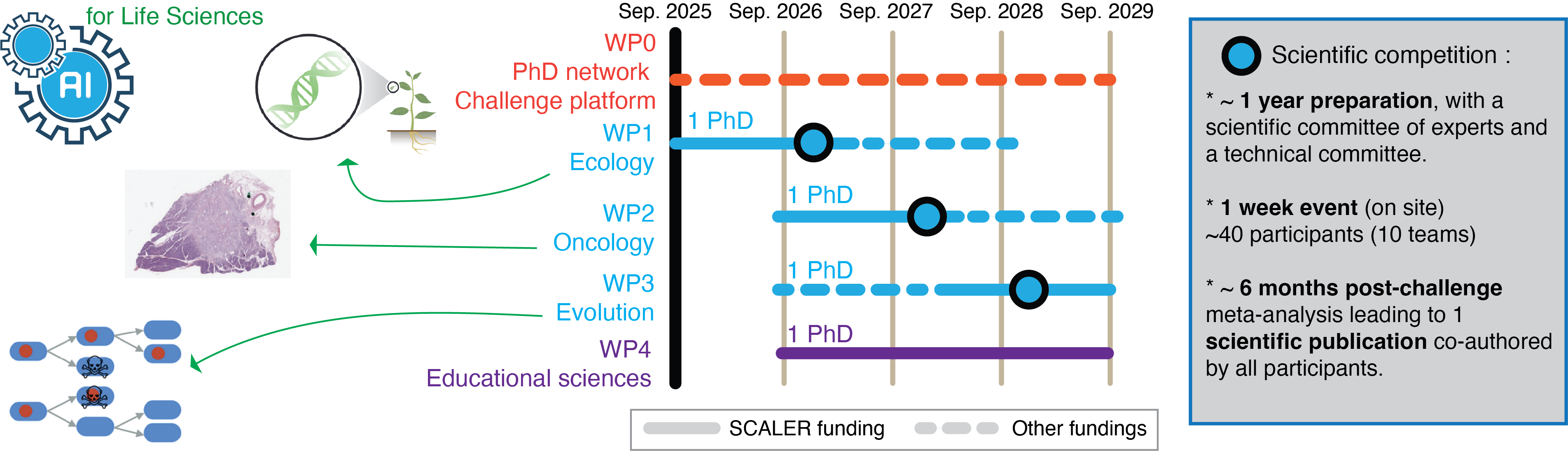
Scientific competitions, or "data challenges," have proven effective for machine learning development by providing clear objectives, benchmark datasets, and standardized evaluation methods. While successful in computer science, their application in life sciences faces unique challenges: complex biological datasets, appropriate evaluation metrics, and translating biological questions into computational tasks.
The SCALER project explores how scientific competitions can advance AI innovation in life sciences. Building on the "Data Challenge @ UGA" initiative and our collaboration with the Codabench platform, SCALER combines methodological research with educational approaches. Our work focuses on four PhD projects. Three address important biological questions: predicting species responses to climate change, analyzing tumor heterogeneity in oncology, and predicting mutation effects in evolutionary biology. These projects will help us understand how to design effective competitions for biological problems. A fourth project examines how competition design affects participant engagement and learning outcomes. SCALER aims to contribute to the field by developing an open-source competition framework, creating guidelines for designing biological competitions, building a network of academic and industry collaborators, and training researchers in competition organization for both research and educational purposes. Through this approach, SCALER seeks to improve how we develop and evaluate AI methods for life sciences while training computational biologists to tackle important biological challenges.
The SCALER project explores how scientific competitions can advance AI innovation in life sciences. Building on the "Data Challenge @ UGA" initiative and our collaboration with the Codabench platform, SCALER combines methodological research with educational approaches. Our work focuses on four PhD projects. Three address important biological questions: predicting species responses to climate change, analyzing tumor heterogeneity in oncology, and predicting mutation effects in evolutionary biology. These projects will help us understand how to design effective competitions for biological problems. A fourth project examines how competition design affects participant engagement and learning outcomes. SCALER aims to contribute to the field by developing an open-source competition framework, creating guidelines for designing biological competitions, building a network of academic and industry collaborators, and training researchers in competition organization for both research and educational purposes. Through this approach, SCALER seeks to improve how we develop and evaluate AI methods for life sciences while training computational biologists to tackle important biological challenges.